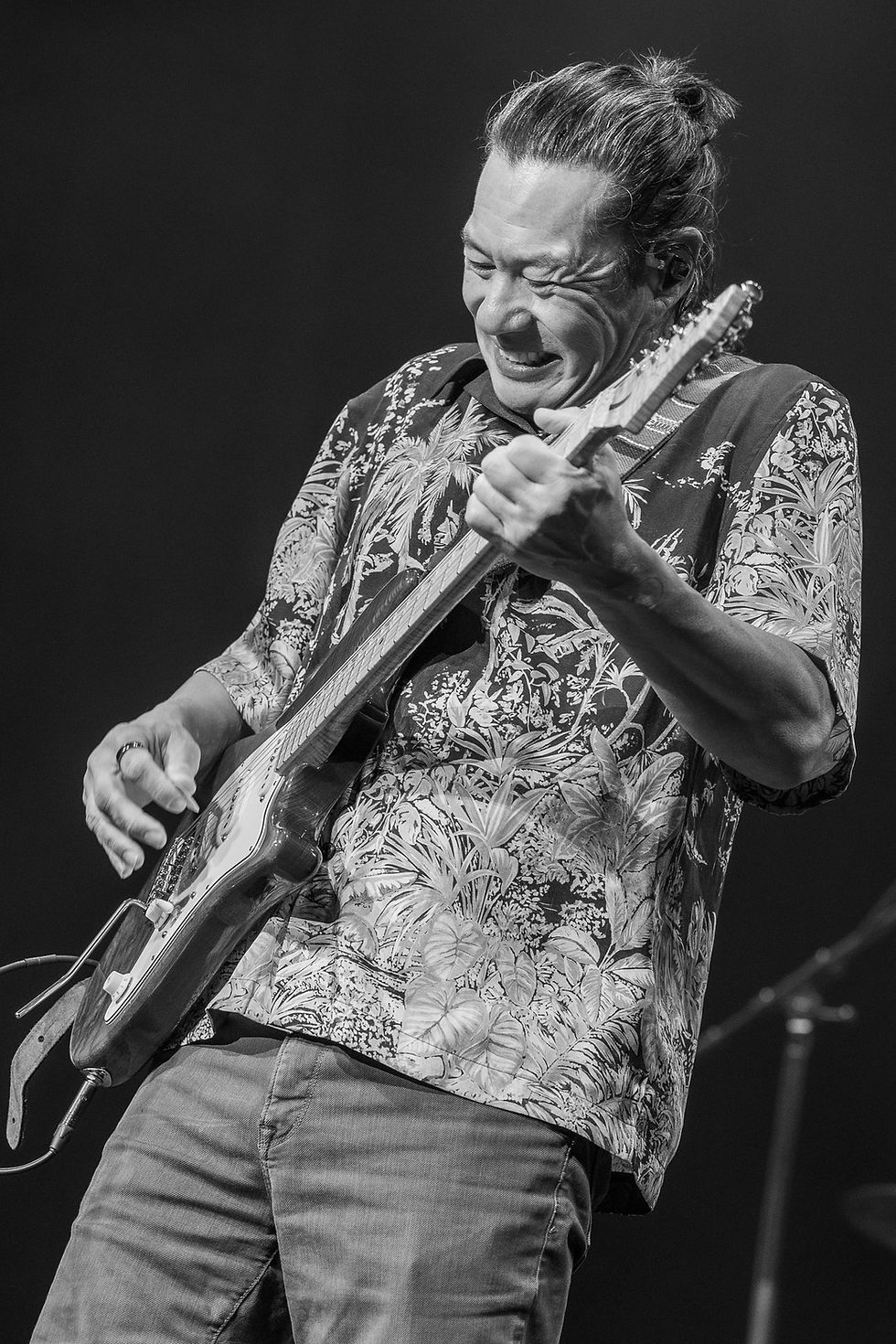
Starting Friendships in the Middle: A Conversation with David Wilcox


David Wilcox had never played music before he arrived at Antioch College. He heard a woman playing Joni Mitchell songs in a stairwell, and he knew right then that he wanted to play. He borrowed her guitar and, that same night, learned many of Joni’s songs and never looked back. What followed has been a steady offering of music from the late '80s until today that invites the listener into the story and creates friendships along the way.
Those familiar with David's music know many, if not most, of his songs involve the use of open tunings. Open tunings retune the guitar so that strumming the open strings, with no fingers on the fretboard, plays a full chord. "At one point I knew about fifty of them," David says. That curiosity about sound has shaped his music since the beginning. In 1978 he tells me, he started "cutting his capos" so they hold down only certain strings. "The result is a fresh sound, with chord voicing that can span a wider range, more like piano chords." The capo, he says, is like the frame around the painting. All this would seem somewhat challenging in a live situation going from one tuning to another, shifting capo positions, all while telling stories. "It can be a dramatic shift if room is quiet or there is ambient noise." But, David says, "If I can really hear, I can go from tuning to tuning very fast."

Wilcox's songs come from real life events, and he says that’s why they can start a great conversation. Some have “metaphorical trap doors,” and even after years of playing them, they can still surprise him and take on new meaning. "Rewriting them is just part of the process, and I love rewriting them," he says.
I asked Wilcox about his time on a large record label. "It was a fun ride," he tells me. " I witnessed the last flourish of the music industry, made music in expensive studios, and played with some of the best musicians in the world." He’s grateful for the generosity he was shown and for riding that wave. But his goals were always to make the work sustainable and to keep the music feeling like his teacher, something he didn’t want to wear out. His last few records have come out on his own label, which he calls "the best deal for the way the industry has changed."

In that regard, I asked him what it's been like over the years going largely from word of mouth success before the internet and streaming platforms. What moves him most now is how people find his music. He says that it's largely now friends telling friends, “You’ve got to listen to this song by David Wilcox. It describes exactly what you’re going through right now.” As a result, he gets to start friendships in the middle rather than at the beginning as a result of the connection through the song. For him, the difference is the person-to-person nature of the music.
That belief carries into everything he does. Each summer he teaches a week of songwriting at the Omega Institute in New York, where he writes spontaneous songs after asking people what they’re going through. "They can be cathartic or funny, but in a beautiful way. It's a beautiful way to meet friend to friend," he says.
I was curious Wilcox's take on the proliferation of AI in the arts. Eloquently, he shared that as more AI artists appear, he sees live music as something different and important. It’s the artist’s presence, surrounded by people who are emotionally attuned to one another. “It’s not just notes and chords,” he says. "It’s an alignment that takes a room to an emotional place and point of view it couldn’t reach alone." That kind of emotional alignment is something humans are really good at, he says, and robots are not.

It was a real treat to have David perform as part of our Stage Door series this year. If you were lucky enough to attend the sold out performance you experienced the emotional alignment that takes place at his shows. The experience of live music in this format truly wonderful, and we hope you'll join us for an upcoming Stage Door show.
Interview and photos: Lindsey McCutchan