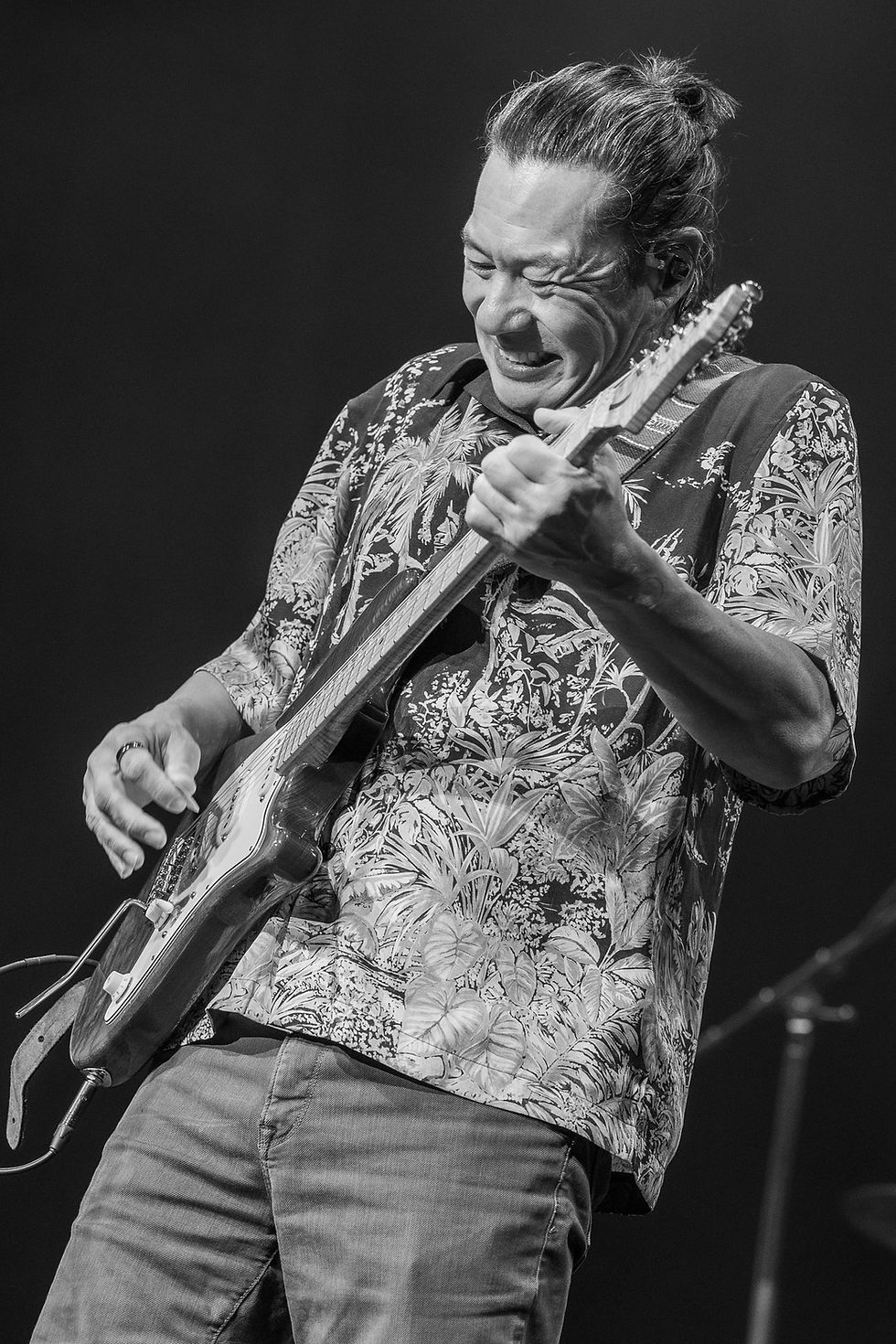
Soul Roots, Modern Heart: A Conversation with Sam Mooney


Words and Photos - Lindsey McCutchan, House Photographer at The Midland Theatre
If you've never been to a Midland Theatre Stage Door show, you most definitely need to add it to your list of "concert to-do's." There's nothing like being on the stage with the artist in an intimate setting hearing stories and discovering new music.
For those lucky enough to have snagged a coveted seat to the Midland Theatre's sold out Stage Door Series show with Sam Mooney, you'll fondly recall Sam's honesty, wit, and charm shared over the course of the evening. I first crossed paths with Sam at a SoFar Sounds show in Louisville, where he held a quiet room rapt with a voice built for intimate spaces. His songs have a way of drawing you in; not with volume, but with honesty. If you’re new to Sam’s music, think soulful piano lines, fluid acoustic guitar, thoughtful storytelling, and heartfelt melodies. I had the opportunity to chat with him about his start as a musician, what he hopes listeners will take away from his music, his songwriting process, pre-show rituals, and some tips for budding creators.
Lindsey McCutchan: Sam, thanks for taking the time to speak with me during what I'm sure is a busy time of the year for you. I wanted to start out our conversation by asking you to share with folks a little bit about yourself.
Sam Mooney: Yeah, absolutely. I grew up in a little town called Brookhaven, MS about 90-minutes north of New Orleans which was a great place to grow up. It was a really supportive place to be as a young artist kicking off my career. Even though it was a small town there were a lot of people who cared about the arts scene. I'm one of seven kids and on the younger end of that group.
On his start with playing and recording music
I started playing piano first and then a few years after that songwriting, but what really sent my love for music into overdrive was discovering Soul music in all its forms. For me it was Ray Charles who was the first artist I ever really did a deep dive on. I fell in love with his catalog and the feel of that music; his voice, and the way he used piano so beautifully. That led me down the road to all of these other artists integral to my journey, you know, Stevie Wonder, Marvin Gay, and Bill Withers who are not only really great songwriters but make some of the best music imaginable. I also have Pop roots. I'm a big John Mayer guy and so my goal in songwriting has been to take those old school influences but translate them in a way I want to. The final breakthrough for me was singing. I was really shy to sing but I didn't want to write the songs and not deliver them. At sixteen I finally had a breakthrough from the stage fright. After that, I started gigging up all over town, doing open mics, talent competitions, and whatever I could find to get on the stage really.
On going to college and prioritizing music
By the time I went to college, I had already put out an EP that had done well and started playing around the region. I went to Ole Miss in Oxford, Mississippi, and I had a great experience in school, but for better or worse I always saw myself as a musician first and a student second you know. I was like, I'm a full-time musician and school's this thing I have to do by day. So I'd get out of class on Friday afternoon and take off for Memphis or Birmingham or whatever town I could go to play whatever gig. And, so I have to say by the time school was over, the the ball was rolling pretty well. I was starting to get some cool opening slots on big shows and the songs were starting to find more and more of an audience online to the point where I could go full time with music.
On life as a musician
Yeah well I'm in Nashville married to a fellow musician, and we've put out a record together on a separate project (Highland Rim), and I mean music's the biggest part of my work life, you know. I do a variety of things really. I get hired a lot to play keys on other people's albums or live shows so I do a ton of gigs that aren't, you know, Sam Mooney shows but also private events, corporate things. Most musicians gig significantly more than their tour dates would show, and I'm no exception. But my favorite thing in the world, is exactly what I got to do at the Midland Theater, which is playing my music to an audience that really appreciates it and is there to listen. It's a challenge to do what we do as creatives. It has its own hard days and heartaches, but for as long as I've been doing it I have never dreaded Mondays. I'm not someone who lives for the weekend and work is this thing I have to get done. I find a lot of joy and purpose in my work and there's always going to be those random difficult times with it, but holistically it's something I love to do. I have never lost my gratitude for how cool it is and I always find a way to get a lot of energy out of it.
On his songwriting process
It depends on the song. I think the best days of songwriting is when they all come at once, you know, in this lightning strike kind of way. That doesn't happen often. Songwriting is a funny mix of discipline and also just luck. It's a funny science because I've written songs I was very proud of where it was this really regimented process of, "I have an idea and I'm going to work on it more from 2 to 330 on Thursday." But I've also had times where I was doing my vocal warm-ups and I hit a chord while I was messing around and it was like, oh, that's something. And then I drop everything I'm doing for 2 hours and start writing right then. So there's this funny convergence of things that ideally happen all at once; something musically or melodically intriguing that happens and then you're inspired to write something lyrically. And then the 3rd component that has to happen. As I get older and my life becomes more layered and busy, if I know I've got something (a song idea), I'll clear the calendar if I can for the next couple hours and knock it out because I know that that spark won't always be there.
On vulnerability in songwriting
It's funny. A lot of the songs I was most anxious to release in my career because they felt really vulnerable have done the best. We often think that vulnerability or real deep honesty is not going to be palatable to the masses. But I think people are actually really hungry for art that's honest, and all of my art has been honest, with the exception of a couple songs where I'm creating stories or running with certain ideas. But I've always written from the heart, and I think there's something about growing up and getting older where there is less to prove to the world and you actually share yourself as you truly are.
On pre-show rituals
It depends on how much time I have and some of it depends a little bit on solo show or band show. If it's a band show, there's always like a little huddle before we go on, you know, 5 minutes before. We do a group break with something funny, some inside joke from the day and talk through the set list really quickly. When it's solo it's a few different things. I would say I either eat dinner or a snack of some kind, you know, ideally like an hour or so before to get loose. I do my vocal warmups to kind of ground myself and I'll give myself a little pep talk. Not so much, "you're gonna crush it" or relating to how I'm gonna do, but more about how I'm gonna try to be present and just enjoy the opportunity and have fun with it. One thing I like to do as much as I can, I have a very romantic relationship with the world and travel, so before the show I love to take a little walk around the neighborhood just to get a sense of what the place is like. You know, what's the energy of the town that night? Is it a really chill Tuesday or is it a hopping Saturday night with everybody out? I like to see what I can gather from that which might inform any last minute set list choices. I usually have an idea of what I'm going to play, you know, before the day of the show, particularly if it's a band show, because we have to rehearse a lot of times. But if it's solo, the only person that has to know it is me and I wrote the songs so it's easier.
On advice to creatives hoping to break into the mainstream
I really think young artists need to hear this. Never let the response to a song affect your belief in how good it is. I have been doing this long enough to know that there is no correlation between how good the song is and how well it will do. In fact, for me personally, I have a handful of songs that I was like, "oh, that one sounds kind of cool throw it on the EP." And it did really well. I also have a handful where I thought, "this is my finest work, and it's gonna set the world on fire," and they maybe did just okay. I once heard somebody say, "your song is as good as it was the day you were most excited about it." Nothing magically happens to your recording once it's on Spotify that changed it and made it not good if you loved it before.
Point B, after you've gotten comfortable with that first part is to give those songs a lot of opportunities to be heard, don't give up on them. By doing that, it may eventually find its audience. You know, I have a song, my most streamed song called "Find My Way," and it had a solid release but had not done a ton from a streaming perspective in its whole 1st year. I just really believed that "it's not that this song isn't good, it's just that people haven't heard it, it's not in people's ears." A song can't go crazy if people aren't hearing it, and so I just really persisted in promoting it, and then, over a year after it was leased it finally started gaining a lot of traction.
And then the other one I would say is just some classic advice, but one mentor told it to me, and I tell it to everybody else, that success is usually the result of sustained focus over a long period of time. There's a saying that people overestimate what they can do in a year and underestimate what they can do in 5 or something like that. And I think as creatives, it's in our nature to be a little bit excitable and we want to chase the fresh new idea and the sparks of inspiration as they come up. And you gotta do that to some extent, but, if you are hoping to turn your creativity into business, and you're making that choice to integrate business and art, there's a switch that you have to be able to flip. To say, "okay, I might be past the initial window of inspiration around this idea, but if I'm going to make it work from a business perspective, I have to see it through." To have that consistency. I think that if you have the hopes to monetize your creativity, there are those times where you have to say, "all right, I'm gonna buckle down, and I'm gonna worry less about trying to have a great next 3 months, and more about a great next 3 years."

Lindsey has been telling the story of our stage for his publication Midwest Riff Review, and we couldn't be more grateful for the partnership. Head over to see more photos, reviews, and interviews from The Midland and beyond at MidwestRiffReview.com.